The Love We Build
On what we feel, what we understand, and what two people create together.
Is loving someone enough to build a relationship with them?
The question may sound contradictory. If love is there, what else could be missing? Yet we can continue to feel deeply for someone with whom we can no longer build a shared life. We can also spend years beside someone and discover that entire parts of their inner world remain unfamiliar to us.
Perhaps, then, asking what we feel when we love is not enough. We can also ask what we do with what we feel. When does an individual experience become something two people create together?
That question leads me to a distinction I find important: loving someone and building love with someone are not quite the same thing. The first can exist within us. The second involves another person—with their own feelings, thoughts, decisions, and way of making sense of life.
I do not think there is a simple answer, or a definition that can encompass every form of love. But we can explore how its emotional and relational dimensions connect, and what part we play in the relationships we develop.

Auguste Rodin, The Cathedral (1908). Photograph by Loris Silvio Zecchinato, CC BY 2.0. A visual metaphor for two individualities creating something together; not scientific evidence.

Feeling love does not fully explain how we love
When we think about romantic love, we often think of falling in love, attraction, the longing to be close, and emotional connection. These experiences matter. Wanting intensely to see someone, finding joy in ordinary moments together, or admiring who they are can become meaningful parts of our lives.
But those feelings do not necessarily tell us how we will act when differences arise, difficulties accumulate, or either person begins to change.
In 1986, psychologist Robert Sternberg proposed his triangular theory of love, describing three components: intimacy, passion, and decision/commitment. Intimacy involves closeness and connection; passion includes attraction and romantic drives; and commitment concerns both the decision to love someone and the intention to sustain that love.
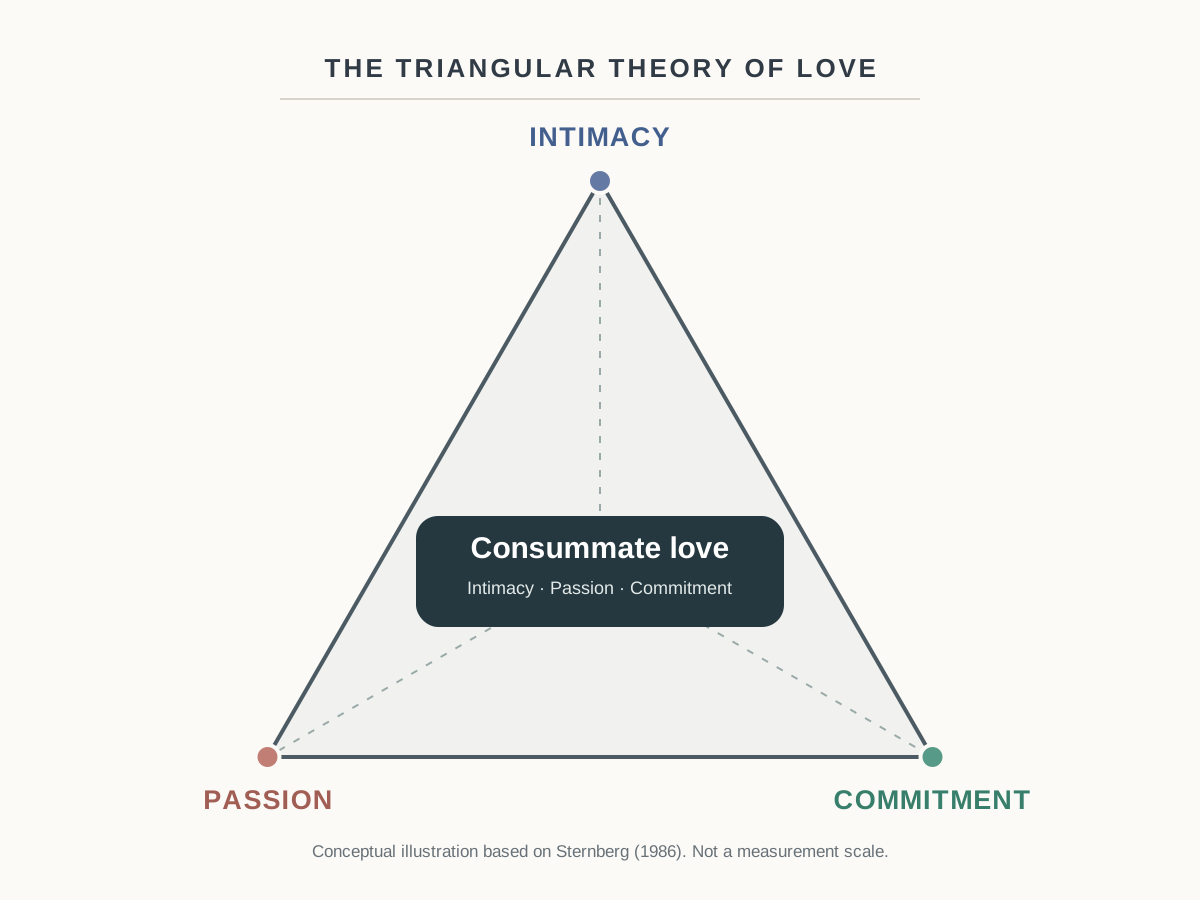
Figure 1. Original illustration based on Sternberg’s triangular theory (1986). In this model, the combination of intimacy, passion, and commitment is called “consummate love.” The diagram is conceptual, not a measurement scale.
One strength of this model is that it helps us understand different experiences of love through components that need not be equally strong. It also helps clarify why a close friendship and a romantic relationship can have so much in common without necessarily being the same kind of bond.
A friendship can involve trust, care, emotional intimacy, admiration, and an enduring commitment to stand by each other. Romantic passion may introduce another dimension: a particular kind of attraction, desire, and emotional connection. In Sternberg’s typology, for example, intimacy combined with commitment is called companionate love, while intimacy combined with passion characterizes romantic love.
This does not mean sexuality is a universal requirement for romantic love, or that every friendship is devoid of passion in the ordinary sense of the word. The model helps us distinguish experiences; it should not be used to place every person’s intimacy into rigid categories. What makes a bond deep and what makes it romantic are related, but different, questions.
Nor should we assume that passion inevitably disappears as a relationship matures. In a 2009 review, Bianca Acevedo and Arthur Aron found that intense romantic love can persist in long-term relationships, especially when distinguished from the obsessive elements that can accompany early infatuation.
Deep love, then, need not mean the end of desire or emotional intensity. The point is that the depth of a relationship can hardly be explained by the intensity of our feelings alone.
We can feel something genuine for another person and still struggle to understand their needs, make room for their changes, or build a life together. That does not make our feelings false. It helps us distinguish them from the relationship we create through them.
Knowing someone also means continuing to discover them
There is an idea I keep returning to: caring about a person involves more than knowing their history, preferences, or most visible traits. It also means taking an interest in what they are living through now: what worries them, what excites them, what they are trying to understand, what they find difficult, and what is changing in their lives.
Getting to know someone does not necessarily end when the relationship begins.
In psychology, Harry Reis and Margaret Clark have studied responsiveness: the ways people come to understand, value, and support each other in close relationships.
Feeling understood does not mean that our partner knows every thought we have or reads every emotion accurately. It can mean sensing that they genuinely want to know our experience and respond to it with care.
Imagine telling a partner about a problem they know very little about. They may have neither the expertise to solve it nor any personal experience of something similar.
Still, they can ask questions, listen, try to understand why it matters, or simply show that they have kept it in mind. They do not need to become an expert in whatever troubles us.
Sometimes caring is not about solving another person’s problems. It is about thinking of them. Keeping them in mind.
That disposition also matters when things go well. In 2004, Shelly Gable and colleagues studied what happens when people share positive events with others. Active, constructive responses to good news were associated with markers of well-being and intimacy.
We often associate support with difficult moments. But genuine interest also shows up in our ability to celebrate what matters to another person, recognize their excitement, and take part in the things that make their life meaningful.
We do not have to share someone’s ambitions to understand that those ambitions matter to them. Perhaps one of the clearest expressions of loving interest is recognizing the value something holds in another person’s life, even when it is not one of our own priorities.
Recognition also has a less visible dimension: it can shape how we see ourselves. Across four studies of felt understanding, Auger and colleagues found that feeling understood could make a particular relationship more central to a person’s self-concept. In a separate longitudinal diary study of couples, Murray and colleagues found that people who generally felt less valued by their partners were more vulnerable to feeling worse about themselves when they perceived possible rejection. These are different findings, but both show why feeling recognized can matter beyond day-to-day relationship satisfaction.
When we experience a sustained lack of interest in important parts of our lives, the hurt may grow beyond a conversation that never happened. We may begin to wonder how much of us our partner really knows, how they see us, and what impression of us they might convey to others. That uncertainty can make it harder to share certain ideas or to feel at ease being ourselves. It is neither an inevitable consequence nor evidence of the other person’s intentions. It is one way to understand why feeling that meaningful parts of our lives go unnoticed can hurt so deeply.
Reciprocity is not a matter of keeping score
If deep love involves attention and care, reciprocity inevitably enters the picture. Yet there is a difference between wanting reciprocity and expecting a relationship to operate as an exchange of equivalent obligations.
Two people do not always have the same emotional resources, knowledge, opportunities, or capacity to help. There may be periods when one person needs much more support than the other. They may face different difficulties, or express affection in different ways.
I therefore think of reciprocity as a mutual willingness to keep the other person in mind, rather than a perfectly equal distribution of effort.
This idea resonates with Margaret Clark and Judson Mills’s research on communal relationships. In such relationships, responding to another person’s needs is not conditional on receiving an equivalent benefit immediately. The focus is on the well-being of those involved, not on balancing a ledger of favors.
This helps explain how someone may devote considerable time and energy to supporting a partner through a difficult period without believing that the other person now owes them an emotional debt.
But not keeping score does not mean that the other person’s willingness to care becomes irrelevant. We can accept substantial differences in how care is expressed while still valuing a shared willingness to understand each other.
Someone may genuinely try to help us without succeeding. They may listen without knowing what to say. They may acknowledge that they lack the tools to support us in a particular way. A lack of results does not, by itself, demonstrate a lack of care.
What matters is the disposition with which both people participate in the relationship and how they respond once they understand the other’s needs. This is a philosophical conclusion we can develop from what we know about relationships, not a universal formula for measuring how much someone loves.
Love can be felt individually. But when we speak of love built between two people, each person’s participation takes on a different significance.
Building an us without giving up the self
The idea of building a deep relationship raises a question: how much of our lives must we share before we truly become an us?
Two people can have different ambitions, careers, interests, and ways of understanding the world. Those differences do not necessarily prevent them from building a meaningful bond.
One quality I find particularly admirable in another person is freedom of thought.
I do not mean merely the freedom to choose a career or make personal decisions. I mean something broader: the willingness to listen, examine ideas, question one’s own interpretations, and understand different perspectives without becoming trapped inside what one already believes.
That openness has a special place in romantic relationships. Understanding a partner does not require sharing every conviction they hold. We can disagree and still care sincerely about the reasons behind their point of view.
There is also a difference between accepting and understanding. We can respect a decision without showing much interest in what it means to the person making it. Understanding asks us to come closer to that experience, take its context seriously, and try to see the world through the other person’s perspective.
Research on the Michelangelo phenomenon, developed by Caryl Rusbult and colleagues, offers a related insight: partners’ perceptions and behaviors can help or hinder each other’s movement toward their ideal selves.
The interesting point is that support does not mean shaping someone into the person we want them to be. It means recognizing their aspirations and relating to them in ways that may help those aspirations develop.
This allows us to think of love as a shared creation that still leaves room for individual growth. We do not need to become the same person to build a life together.
Perhaps a deep union is not defined by the disappearance of differences, but by the ability to live with them, understand them, and build something shared without losing our individuality.
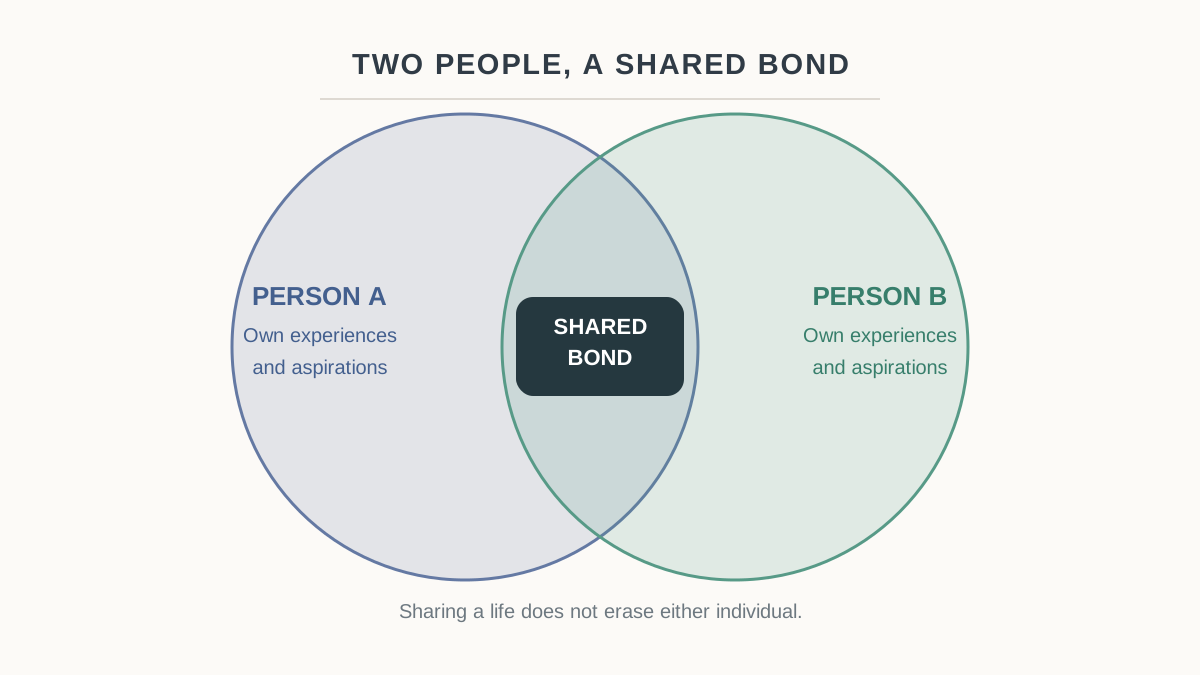
Figure 2. Two individual lives and a shared bond. Original conceptual illustration for this essay—not an established psychological model.
Admiration belongs here as well. We may admire someone’s way of thinking, sensitivity, values, curiosity, or ability to consider unfamiliar perspectives. None of these has to depend on financial success, professional achievement, or the ability to face every difficulty alone.
We can deeply value someone who is uncertain, needs support, or is still discovering what they want from life.
And because people change, love faces an ongoing task: remaining curious about who the other person is becoming, rather than staying attached only to who they were when we first met.
Becoming aware of how we love
So far, we have considered several dimensions of love: emotion, intimacy, understanding, care, reciprocity, and freedom. But another question matters deeply to me: what happens when we become aware of our own ways of loving?
Many of our behaviors develop without deliberate reflection. We may learn how to support someone through experience, respond spontaneously to their needs, or develop habits that make living together easier.
We do not need to study psychology or analyze every action in order to love someone genuinely. Yet we can also grow accustomed to patterns without examining how they work. Repetition makes behaviors familiar. And what feels familiar may stop drawing our attention even when it has a significant effect on our relationships.
Reflection offers another possibility: noticing what we are doing, exploring why we act as we do, and asking what consequences our behavior has for ourselves and for others.
Psychology offers a related concept, mentalization: the capacity to understand our own and other people’s behavior in terms of thoughts, feelings, desires, and intentions.
A 2026 systematic review by Katie Hurman and colleagues found a moderate positive association between mentalization and relationship satisfaction. The researchers also noted important limits on causal conclusions and on what can currently be said about interventions designed to improve this capacity.
That evidence invites us to examine a possibility, although it does not prove a universal causal relationship: deliberate reflection may help us recognize and change patterns we would otherwise continue to repeat.
We may notice that our usual response to a concern is not providing the support our partner needs. We may realize we have interpreted a situation entirely from our own perspective. Or we may discover that something we considered unimportant means a great deal to the other person.
Awareness does not guarantee that we will know how to resolve these differences. But it can create room to learn, talk, and choose a different response.
It also matters to recognize that being self-aware does not mean being right. We can reflect deeply and arrive at the wrong interpretation. We can attribute intentions the other person never had, or believe we understand a situation perfectly when crucial information is still missing.
The awareness I am interested in, then, is not endless analysis of every detail of a relationship. It is a willingness to revise what we think we understand—including our own conclusions.
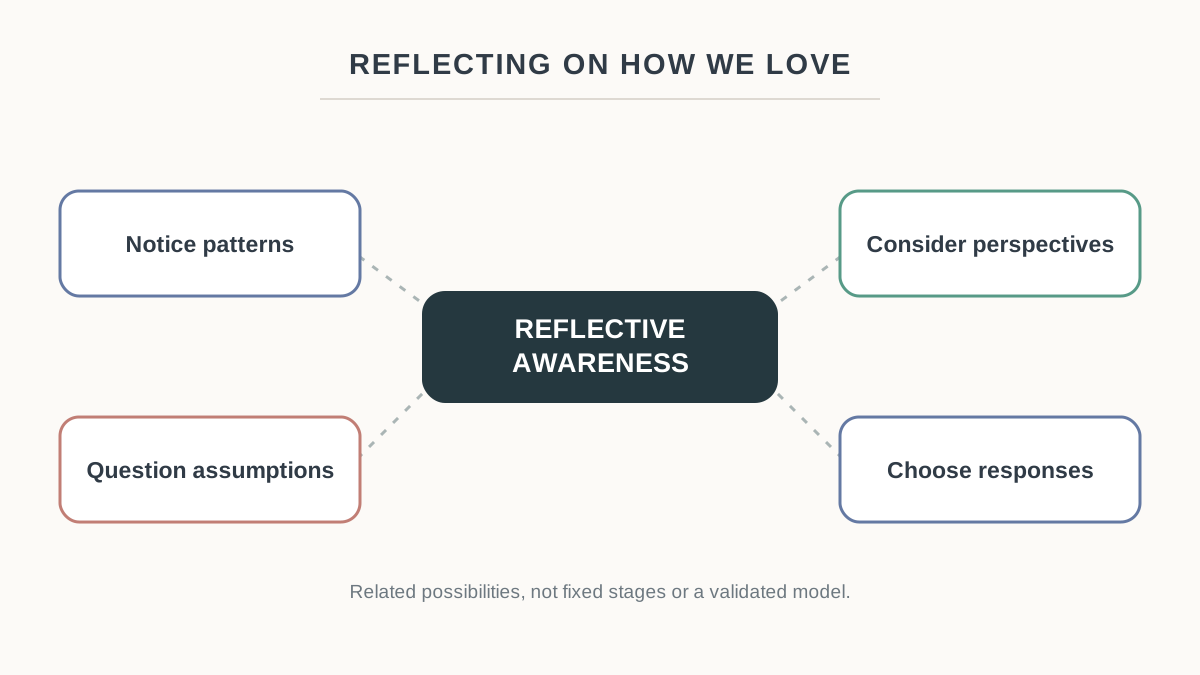
Figure 3. Some possibilities associated with reflective awareness in relationships. Original illustration; not a causal or experimentally validated model.
At that point, awareness and freedom of thought meet again.
Taking responsibility for what we build
If we can recognize our behavior and better understand its consequences, we can also ask what responsibility we bear for it.
In love, responsibility should not be confused with an obligation to solve every difficulty our partner encounters. Nor does it mean agreeing to every request or abandoning our own needs. I understand it as a willingness to recognize our part in the relationship and take seriously what the other person communicates to us.
Every relationship brings together two distinct subjective experiences. Even when our intentions are good, our actions may not be received the way we expect.
Someone may try to care but fail to communicate that care. Someone else may need something their partner does not know about, does not understand, or cannot provide.
Communication makes needs, boundaries, and interpretations visible when they might otherwise remain implicit. But hearing about a need does not automatically resolve it. What we do with what we have learned also matters.
Sometimes we can change our behavior. Sometimes we need to explain why we cannot respond in a certain way, offer an alternative, or acknowledge a difference that has no simple solution. What matters is genuine participation in that conversation.
From this perspective, taking responsibility for how we love involves examining both what we offer and how we recognize the love we receive.
We may take another person’s care for granted without fully understanding its value. We may also express affection in a way that feels obvious to us but does not meet what the other person needs.
Reflective responsibility can help us notice those differences.
Love does not stand still
People change over time. Their interests, ambitions, concerns, circumstances, and ways of understanding themselves change. The conditions in which a relationship develops change as well.
It is difficult, then, to think of deep love as a state we reach once and keep unchanged thereafter.
Relationship psychology studies how bonds develop through accumulated interactions. A 2017 review by Eli Finkel, Jeffry Simpson, and Paul Eastwick brought together principles concerning interdependence, responsiveness, individual characteristics, and context to explain how close relationships function.
Stability can be valuable. Familiarity can provide security. Routine can be part of a satisfying relationship. We do not need to assume that what becomes habitual has lost its depth.
But neither should we confuse the continuation of a relationship with the quality of the bond within it. People stay together for different reasons, and the feelings they retain do not necessarily tell the whole story of how they are building their shared lives.
That returns us to the opening question. Is love what we feel for someone, or what we build with them?
Perhaps the more useful answer is that these are different, though deeply connected, dimensions.
What we feel may draw us toward another person, motivate us to know them, and awaken a desire to share a life. What we build also depends on our actions, mutual recognition, each person’s possibilities, and how we respond as life changes.
Choosing to keep knowing each other
After considering these perspectives, I do not think deep love can be reduced to any single characteristic.
Attraction matters. Intimacy matters. Desire, trust, care, reciprocity, and commitment may play different roles throughout a relationship.
Yet one idea runs through many of these dimensions: a genuine interest in the person beside us.
That interest does not require perfect understanding. It does not require solving their difficulties, sharing every ambition, or possessing the same abilities. It means remaining willing to know them, recognize what they are living through, and consider how our participation in the relationship affects us both.
This is where awareness has a particular value.
We can love spontaneously. But we can also learn about how we love. We can revisit our behavior, recognize needs we did not see before, and discover other ways of expressing what we feel.
Not because love should become a permanent exercise in analysis, but because the people involved in it never stop changing.
Perhaps building a deep love means accepting just that: knowing someone is never an entirely finished task. A relationship is sustained not only by having chosen a person at one point in time, but also by a willingness to keep discovering them while both people continue building their own lives.
Loving someone may begin as an individual experience. Building a shared love also means learning to keep each other in mind.
References
- Acevedo, B. P., & Aron, A. (2009). Does a Long-Term Relationship Kill Romantic Love? Review of General Psychology, 13(1), 59–65. https://doi.org/10.1037/a0014226
- Auger, E., Thai, S., Birnie-Porter, C., & Lydon, J. E. (2025). On Creating Deeper Relationship Bonds: Felt Understanding Enhances Relationship Identification. Personality and Social Psychology Bulletin, 51(11), 2248–2265. https://doi.org/10.1177/01461672241233419
- Clark, M. S., & Mills, J. (1979). Interpersonal Attraction in Exchange and Communal Relationships. Journal of Personality and Social Psychology, 37(1), 12–24. https://doi.org/10.1037/0022-3514.37.1.12
- Finkel, E. J., Simpson, J. A., & Eastwick, P. W. (2017). The Psychology of Close Relationships: Fourteen Core Principles. Annual Review of Psychology, 68, 383–411. https://doi.org/10.1146/annurev-psych-010416-044038
- Gable, S. L., Reis, H. T., Impett, E. A., & Asher, E. R. (2004). What Do You Do When Things Go Right? The Intrapersonal and Interpersonal Benefits of Sharing Positive Events. Journal of Personality and Social Psychology, 87(2), 228–245. https://doi.org/10.1037/0022-3514.87.2.228
- Hurman, K., Shaikh, M., Greene, T., & O’Driscoll, C. (2026). Mentalization and Couple Relationships: A Systematic Review of Associations and Interventions. Psychology and Psychotherapy. https://doi.org/10.1111/papt.70102
- Murray, S. L., Griffin, D. W., Rose, P., & Bellavia, G. M. (2003). Calibrating the Sociometer: The Relational Contingencies of Self-Esteem. Journal of Personality and Social Psychology, 85(1), 63–84. https://doi.org/10.1037/0022-3514.85.1.63
- Reis, H. T., & Clark, M. S. (2013). Responsiveness. In The Oxford Handbook of Close Relationships (pp. 400–424). https://doi.org/10.1093/oxfordhb/9780195398694.013.0018
- Rusbult, C. E., Finkel, E. J., & Kumashiro, M. (2009). The Michelangelo Phenomenon. Current Directions in Psychological Science, 18(6). https://doi.org/10.1111/j.1467-8721.2009.01657.x
- Sternberg, R. J. (1986). A Triangular Theory of Love. Psychological Review, 93(2), 119–135. https://doi.org/10.1037/0033-295X.93.2.119
© 2026 Franle
If you share or quote this essay, please credit the author and link back to the original.