When Understanding Isn't Enough
Understanding an idea doesn't necessarily mean we've learned to think with it.
Some ideas seem impossible to forget while we are reading them.
We encounter a reflection about human behavior, recognize something familiar, and immediately understand what it means. The explanation seems convincing, perhaps even obvious. For a moment, we feel that we have discovered a new way of looking at something.
Then we return to our lives.
Days later, we may encounter a situation in which that same idea would be relevant. Yet we do not necessarily recognize the connection. The knowledge may still be somewhere in our memory, but it does not become part of how we interpret what is happening.
This suggests a distinction that is easy to overlook: understanding an idea is not necessarily the same as having learned to think with it.
We can know a principle without recognizing when it matters. We can recognize a situation without remembering the concept that describes it. And sometimes we can use abilities that we do not yet know how to explain.
The interesting question, then, is not simply how we acquire knowledge. It is how knowledge becomes something we can recognize, examine, and use beyond the moment in which we first encountered it.

The Geographer (1669), Johannes Vermeer. Städel Museum, Frankfurt am Main. The work portrays a pause between measurement and interpretation. Artwork and collection.
Understanding with the explanation in front of us
There is a difference between following an explanation and being able to construct one independently.
In 2002, psychologists Leonid Rozenblit and Frank Keil investigated what they called the illusion of explanatory depth. Their research showed that people frequently overestimated how deeply they understood familiar mechanisms. When asked to explain those mechanisms in detail, they became more aware of the limitations of their knowledge.
This finding does not mean that every moment of understanding is an illusion. It reveals something more specific: our confidence in an explanation may exceed our ability to explain it.
Consider what happens when we read about a cognitive bias. The concept is defined, the examples are selected, and the relevant connections have already been established. Following the reasoning may require relatively little effort.
But encountering a similar phenomenon in an unfamiliar situation presents a different challenge. We must identify which information matters, distinguish relevant similarities from superficial ones, and determine whether the explanation actually applies.
Research on learning and performance reinforces this distinction. In a 2015 review, Nicholas Soderstrom and Robert Bjork explained why good performance during learning does not always indicate durable learning. What we can demonstrate immediately after instruction may differ considerably from what we retain or transfer later.
An idea can be clear while we are examining it without becoming equally accessible when the surrounding context changes. Understanding has value, but its immediate clarity tells us little, on its own, about how flexible that knowledge has become.
Knowledge does not announce when it matters
Imagine reading several news articles that appear to support the same claim. Each presents the information confidently, and the repetition creates an impression of independent confirmation. Yet all the articles may ultimately rely on one original source.
A person might understand perfectly well that repeated information does not necessarily constitute independent evidence. But recognizing that principle in a real situation requires something more than recalling its definition: it requires identifying when the principle has become relevant.
This is part of what psychologists study as transfer of learning: using knowledge or skills in circumstances different from those in which they were acquired.
In experiments published in 1980, Mary Gick and Keith Holyoak investigated analogical problem-solving through a military story and a medical problem that shared an underlying structure. Participants were more likely to use the earlier story when they received a hint directing them toward the analogy. Without the hint, recognizing and applying the connection was much less common.
The knowledge could be available without its relevance being spontaneously recognized.
Outside a lesson or exercise, nobody announces that we are about to encounter an example of a principle we studied months earlier. We must recognize the connection ourselves.
Susan Barnett and Stephen Ceci, in their 2002 review, emphasized that transfer cannot be treated as one uniform ability. It depends on what was learned, what is required later, and how the contexts differ.
Knowing something in one setting therefore does not guarantee that we will recognize its usefulness everywhere else. The difficulty is not always a lack of knowledge. Sometimes it is the distance between possessing knowledge and recognizing the situation in which it can help us.
Sometimes experience comes before explanation
There is another direction in which learning can develop.
We often associate understanding with learning a concept and then putting it into practice. But many abilities emerge from experience before we can explain the principles that guide them.
A musician may recognize a change in rhythm without consciously describing its structure. Someone familiar with negotiation may know when to adjust the tone of an exchange before being able to formulate precisely why that adjustment seems appropriate.
These examples illustrate a distinction between performing an action and being able to explain the knowledge involved in it.
Zoltan Dienes and Josef Perner, in their 1999 theoretical work, examined different forms of implicit and explicit knowledge. Their analysis highlights why these concepts cannot simply be reduced to unconscious versus conscious activity.
We may be aware of what we are doing without having an explicit explanation of how we learned to do it or which regularities guide our behavior. Later, reflection, comparison, and study may help us articulate aspects of that knowledge.
In this case, theory does not necessarily create the ability. It can help us understand a capacity that has already developed through experience.
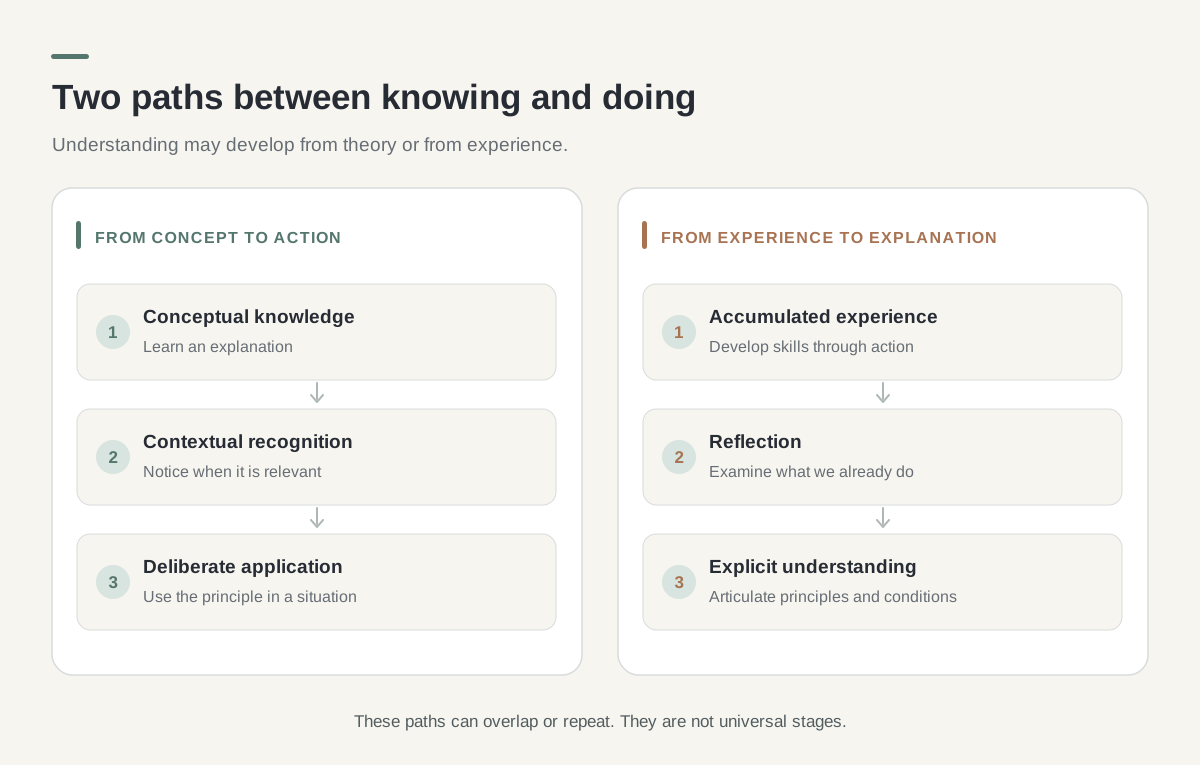
Two possible paths between knowing and doing. This is a conceptual illustration, not a universal sequence or a validated psychological model.
This is where metacognition becomes relevant.
John Flavell’s foundational work examined our knowledge and monitoring of cognitive processes. Gregory Schraw subsequently distinguished between knowledge of cognition and regulation of cognition: what we know about our thinking, and how we plan, monitor, and evaluate it.
The distinction matters because observing a pattern is not the same as examining our own interpretation of it.
We may recognize a familiar situation almost spontaneously. But when we ask why we reached a particular conclusion, what evidence supports it, or whether our confidence is justified, we begin to evaluate our own reasoning.
Greater self-understanding can also reveal something that is often overlooked. It need not involve discovering only mistakes or limitations. It can help us identify abilities we were already using, understand when they are effective, and examine how to develop them further.
Sometimes learning means acquiring something new. At other times, it means understanding more clearly what we already knew how to do.
Recognizing something is not the same as being right
Recognizing a pattern does not guarantee that our interpretation is correct.
A theory may explain why a behavior could occur without proving that the same mechanism explains a particular situation. Likewise, previous experience can make an interpretation seem familiar without establishing that all its assumptions are justified.
We can distinguish between having a plausible explanation, finding evidence that supports it, and discovering whether later information requires us to reconsider it. These are related but different accomplishments.
Metacognition contributes another dimension: evaluating not only our conclusions but also the processes through which we reached them.
The purpose is not to doubt every thought indefinitely, or to transform every ordinary experience into a scientific investigation. It is to recognize that a well-founded interpretation depends on more than how convincing it feels.
Knowledge can become part of our thinking not only when we recognize more situations, but also when we develop better criteria for evaluating what we recognize.
Knowledge does not require permanent attention
If understanding our cognitive processes is valuable, should we constantly analyze what we think and do?
That conclusion would confuse the integration of knowledge with its continuous presence in consciousness.
We do not need to reconstruct every principle behind a skill whenever we use it. Nor do we need to examine every conversation in psychological terms. Some interactions call for careful reflection. Others can simply be experienced.
The ability to recognize a relevant pattern does not require searching for one at every moment.
A person can understand how social influence operates and still enjoy an ordinary conversation without analyzing its participants. Someone can develop useful knowledge about decision-making without consciously reviewing a theory before every choice.
What matters is not maintaining every idea permanently at the center of attention, but whether knowledge remains accessible and useful when circumstances make it relevant.
Sometimes its influence appears as a distinction we have learned to make, an assumption we are more willing to question, or a relationship we recognize in a situation that initially seems unfamiliar.
None of this makes our judgments infallible. Knowledge can remain incomplete, interpretations can be mistaken, and experience can require us to revise what we thought we understood.
But it offers a more meaningful way to think about the relationship between learning and awareness.
An idea may stay with us as something we can explain. It may also become a resource we use to interpret experiences, assess conclusions, or understand abilities we previously exercised without much reflection. Those are not necessarily the same achievement.
The difference between a momentary reflection and an integrated understanding is not how long an idea occupies our attention, but what becomes possible when we encounter it again in the world.
References
- Barnett, S. M., & Ceci, S. J. (2002). When and where do we apply what we learn? A taxonomy for far transfer. Psychological Bulletin, 128(4), 612–637. https://doi.org/10.1037/0033-2909.128.4.612
- Dienes, Z., & Perner, J. (1999). A theory of implicit and explicit knowledge. Behavioral and Brain Sciences, 22(5), 735–755 (target article; followed by commentary). https://doi.org/10.1017/S0140525X99002186
- Flavell, J. H. (1979). Metacognition and cognitive monitoring: A new area of cognitive–developmental inquiry. American Psychologist, 34(10), 906–911. https://doi.org/10.1037/0003-066X.34.10.906
- Gick, M. L., & Holyoak, K. J. (1980). Analogical problem solving. Cognitive Psychology, 12(3), 306–355. https://doi.org/10.1016/0010-0285(80)90013-4
- Rozenblit, L., & Keil, F. (2002). The misunderstood limits of folk science: An illusion of explanatory depth. Cognitive Science, 26(5), 521–562. https://doi.org/10.1207/s15516709cog2605_1
- Schraw, G. (1998). Promoting general metacognitive awareness. Instructional Science, 26, 113–125. https://doi.org/10.1023/A:1003044231033
- Soderstrom, N. C., & Bjork, R. A. (2015). Learning versus performance: An integrative review. Perspectives on Psychological Science, 10(2), 176–199. https://doi.org/10.1177/1745691615569000
© 2026 Franle
If you share or quote this essay, please credit the author and link back to the original.